
Timeline
Binero
Binero
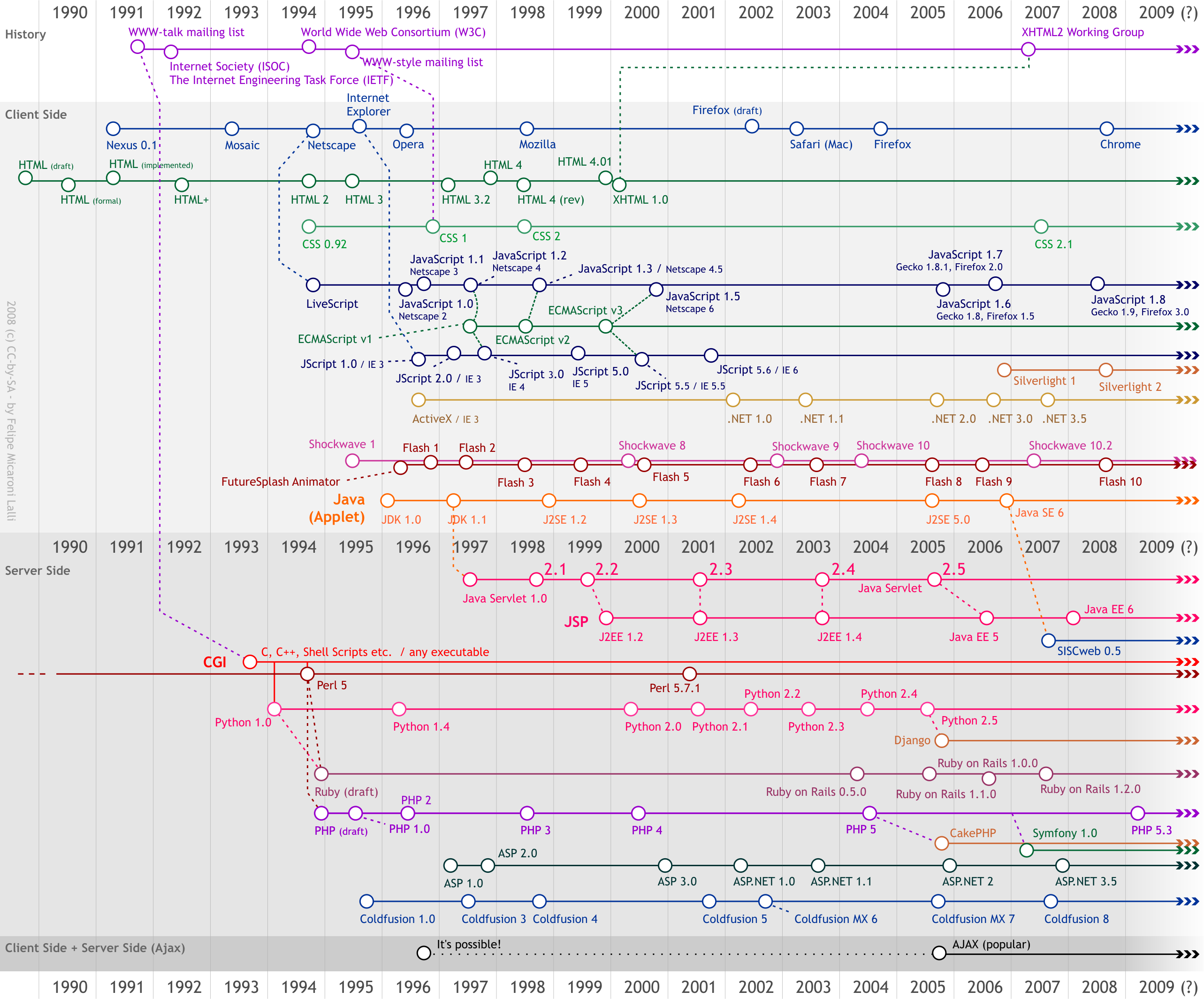
A timeline of the history of the World Wide Web
Key dates, browsers, technologies and ideas in the history of the World Wide Web. Originally compiled by John Allsopp from Web Directions we welcome your suggestions. Justemail them to me.
New York Times
1910ideas
The Mundaneum
Founded by Paul Otlet (who outlined a concept of a globally connected network of computers in 1934) and Henri La Fontaine, The Mundaneum aimed to "gather together all the world's knowledge and classify it according to a system they developed called the Universal Decimal Classification".
Wikipedia
1941ideas
The Garden of Forking Paths
First published in 1941, Jorge Luis Borges short story 'The Garden of Forking Paths' is considered to prefigure ideas of hypertext.
Tipographos
Tipographos
January 7, 1945ideas
As we may think
The Atlantic Monthly publishes the seminal As We May Thinkby Vannevar Bush, widely considered to be the origin of the idea of HyperText. It imagined a device called the Memex, 'a sort of mechanized private file and library'.
Wikipedia
1963ideas
HyperText
Ted Nelson, father of the Xanadu hypermedia system, coins the term HyperText
1970ideas
Markup Language
Charles Goldfarb, co-inventor of the first markup language GML, and designer of SGML, coins the term "markup language"
SGML Source
May 1973technologies
GML (Generalized Markup Language) developed
At IBM Charles Goldfarb, Ed Mosher and Ray Lorie invent GML at IBM. Widely considered the first modern markup language, and a precursor to languages like SGML, XML, HTML . Goldfarb went on to design SGML and XML. Work began in 1969, the name GML was coined in 1971, and the first public appearance was in May 1973.
SGML Source
1974technologies
SGML
Charles Goldfarb begins work on what will become SGML. HTML until HTML5 is an application of SGML.
Vint Cerf ibiblio
January 12, 1974technologies
RFC 675
The first mention of the term Internet appears in theSpecification of Internet Transmission Control Program, authored by Vinton Cerf, Yogen Dalal and Carl Sunshine.
October 1986technologies
SGML Standard published
The ISO publishes ISO 8879:1986, the finalized SGML standard.
WebWonks
1987ideas
HyperCard
Apple's hypermedia and programming development toolHyperCard is released.
Text Files
1987technologies
GIF 87a Introduced
The original image format for the web, the Graphics Interchange Format was originally associated with the online service CompuServe
Wikipedia
December 18, 1987technologies
Perl 1.0 released
Larry Wall releases v 1.0 of the widely used scripting language Perl. Perl has been described as the "Swiss Army knife of the web"
W3C
January 3, 1989milestones
Information Management, a Proposal
Tim Berners-Lee circulates a proposal "concern[ing] the management of general information about accelerators and experiments at CERN". It "discuss[ed] the problems of loss of information about complex evolving systems and derives a solution based on a distributed hypertext system".
W3C
1990browsers
WorldWideWeb the first web browser
Developed by Tim Berners-Lee, famously on a NeXT computer, WorldWideWeb was the the original web browser (and also editor). It was later renamed "Nexus"
1991technologies
HTML Tags
The first publicly available description of HTML, "HTML Tags". It featured several elements still in use today, including headings (level h1 to h6), paragraphs (p), a number of different types of list, and anchor elements with href attributes. It also featured a number of elements no longer part of HTML.
1991technologies
HTTP 0.9
Tim Berners-Lee specifies the HyperText Transfer Protocol (HTTP) 0.9
January 11, 1991milestones
The oldest extant web page
The oldest web page continually served was last modified on Tuesday November 13 1990.
June 6, 1991milestones
Surfing the Net
Brendan Kehoe uses the term 'net-surfing' for the first recorded time
Wikipedia
June 8, 1991milestones
The WWW Project is announced
Newsgroups: alt.hypertext "The WWW project was started to allow high energy physicists to share data, news, and documentation. We are very interested in spreading the web to other areas, and having gateway servers for other data"Tim Berners-Lee
September 1991milestones
www-talk
Tim Berners-Lee starts the www-talk mailing list to discuss the development of the World Wide Web
Wikipedia
1992browsers
Lynx Released
Developed at the University of Kansas, Lynx is a text based web browser. Still in development, it is considered to be "the oldest web browser still in general use".
Wikipedia
February 5, 1992browsers
Line Mode Browser
The second browser after WorldWideWeb, LMB was developed by Tim Berners-Lee, Henrik Frystyk Nielsen and Nicola Pellow at CERN. Platform independent, it ran on a wide number of Operating Systems, and supported FTP, NNTP, as well as HTTP.
Wikipedia'>WWW.png">Wikipedia
March 9, 1992browsers
Viola WWW Browser released
Considered to be the first popular browser, ViolaWWW, developed by Pei-Yuan Wei. It implemented a style sheet language, viola-style, and a scripting language, both years before CSS and JavaScript.
November 16, 1992browsers
MidasWWW Browser Released
Developed at the Stanford Linear Accelerator Center, by Tony Johnson, MidasWWW featured
1) Multifont hypertext display
2) Extensive online HELP
3) Source code viewer
4) Motif Style Guide compatibilty
5) Runs under UNIX and VMS
www-talk mailing list
Wikipedia
January 5, 1993browsers
Mosaic Browser released
Dubbed the killer app for the web, Mosaic was developed at the NCSA at the University of Illinois Urbana-Champaign, originally by Marc Andreessen and Eric Bina for the X Window System UNIX GUI. Mosaic was ported to the Macintosh and Windows Operating Systems.
February 25, 1993technologies
proposed new tag: IMG
Marc Andreesen proposes the img element, on the www-talk mailing list.
June 1993technologies
Hypertext Markup Language (HTML) IETF first Draft
Tim Berners-Lee and Dan Connolly publish the first draft of a specification for HTML. This becomes RFC 1886 Hypertext Markup Language - 2.0 in late 1995
December 15, 1994browsers
Netscape Navigator 1.0 Released
Co-developed by Marc Andreesen, who also co-developed the original Mosaic browser, Netscape Navigator was the first highly popular commercial browser.
March 1995technologies
HTML 3
A draft specification of HTML 3 was published in March 1995, but never finalized. HTML 3.2 was the first specification of HTML finalized by the W3C.
March 1995
Netscape Navigator 1.1 Released
Version 1.1 of Netscape Navigator introduced tables to HTML
Wikipedia
April 10, 1995browsers
Opera 1.0 released
Originally a research project of Telenor, a Norwegian telecommunications company, Opera Software was founded August 1995
Wikipedia
June 8, 1995technologies
PHP Announced
Rasmus Lerdorf announces the first release of PHP on comp.infosystems.www.authoring.cgi. It was originally called "Personal Home Page Tools (PHP Tools)".
Wikipedia
August 16, 1995browsers
Internet Explorer 1.0 released
Microsoft's first web browser is released, based on source code licensed from Spyglass, itself derived from NCSA Mosaic. It was only supported on Windows 95 (Internet Explorer 1.5 ran on Windows NT)
August 19, 1995technologies
JavaScript released
Code named Mocha, called LiveScript in Netscape 2.0, and renamed JavaScript in Netscape 2.0b3, this was the first widely supported scripting language for web browsers. Designed by Brendan Eich, its introduction was not without controversy, being described by Robert Cailliau, Tim Berners-Lee's earliest collaborator on the World Wide Web project as "the most horrible kluge in the history of computing".
September 18, 1995browsers
Netscape Navigator 2.0 Released
Netscape Navigator 2 introduced support for
JavaScript
Java
client side image maps
HTML Frames
GIF89a
plugins, animated GIFs, as well as the font, div and textarea HTML elements.
November 1995technologies
RFC 1886 Hypertext Markup Language - 2.0
Tim Berners-Lee and Dan Connolly publish the first official standardization of HTML, HTML 2.0 as an IETF Request For Comment (RFC).
Wikipedia
November 22, 1995browsers
Internet Explorer 2.0 released
Internet Explorer 2 ran on Windows 3.1, in addition to Windows 95 and NT. A Macintosh version followed in 1996. It featured
JavaScript
HTTP Cookies
VRML
HTML Tables and Frames

No comments:
Post a Comment